

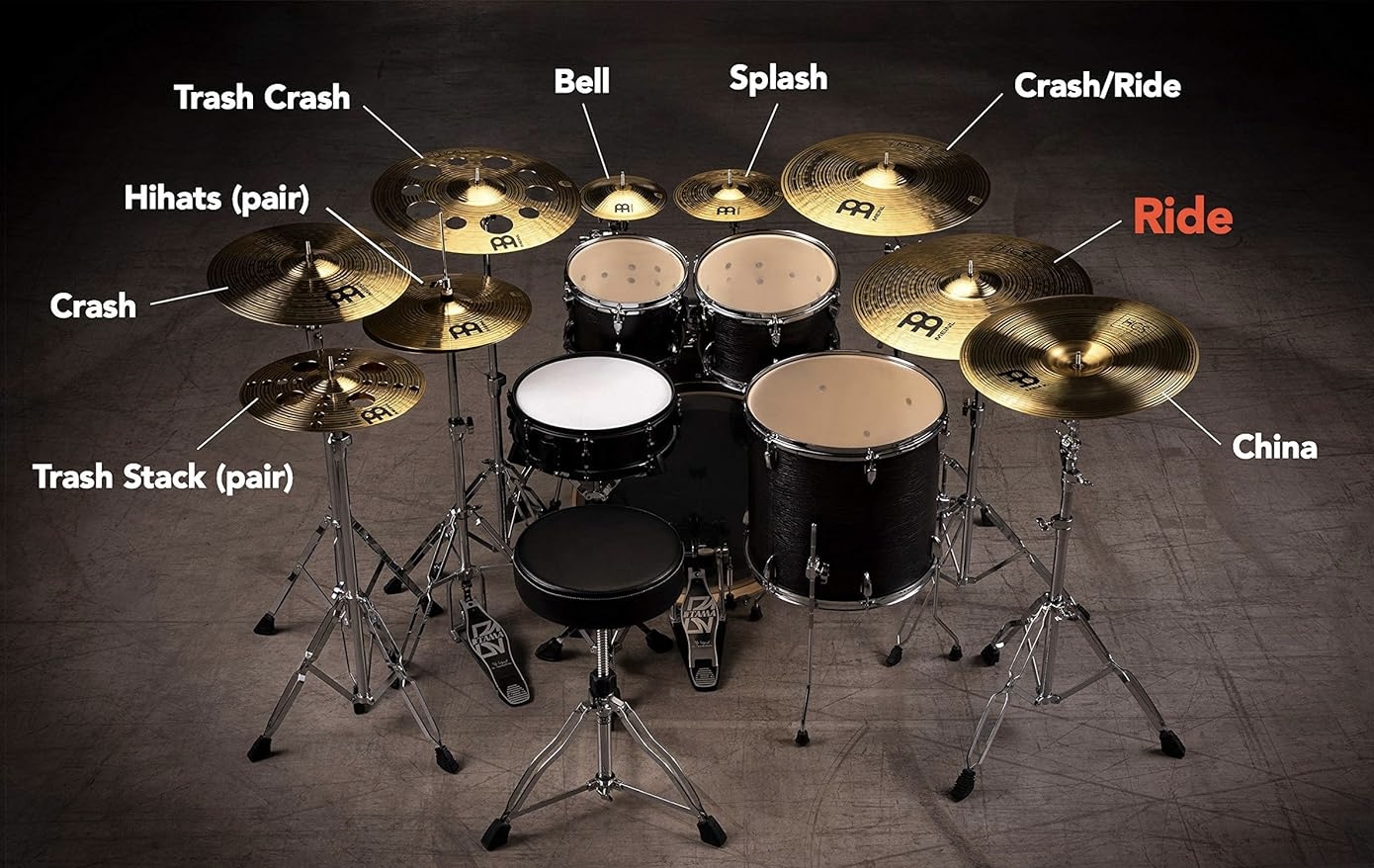
The choice of cymbals is as unique as the player themselves. In this digital age with more transactions occurring online, deciding on the right cymbal sound becomes somewhat problematic.
To begin, let’s review the common types of cymbals and features.

Each one of these have distinct tonal qualities and applications within a typical music set up.
For the purpose of this article, we will concentrate on the primary cymbal groups, namely Hi Hats, Crash and Ride. We will leave the secondary and effects cymbals for a future article.
Cymbals by nature consist of three individual sound regions…

Each of these regions will respond with a different tone. As well, the weight, diameter and alloy will all impact the sounds associated with each area of the cymbal. We will assume that all cymbals offered, are a B20 (20% tin/80% copper) alloy.
Bell
The bell of the cymbal has typically the highest frequency and the smallest area being at the “Hub” of the cymbal. Often used to cut through stage volume, it is the distinct high pitched sound heard in many recordings.
Bow
It is the largest region of the cymbal and used most frequently on Ride and top Hi Hat cymbals. Therefore, this constitutes the most important sound to drummers and their selection of Ride and Hi Hat Cymbals.
Edge
Hitting the cymbal at the edge, provides the sonically fullest sound and the most common region hit on crash cymbals.
So how do these three regions and other criteria help in choosing a cymbal or cymbal set?
Range
To illustrate the high, low and mid notes a cymbal can produce, play with drumsticks (tip) or mallets on various parts of the bow, and the stick shoulder on the bell and edge. On hand cymbal pairs, the overtones can be heard in the sustain after they are played.
Projection & Volume
Projection and volume can be heard when playing the bell and edge of the cymbal with the shoulder of a drumstick. On suspended cymbals, this can be heard at the end of a loud roll, and this is heard on the initial crash on hand cymbals. Keep in mind that cymbals with greater projection typically have one or more of the following relative attributes: larger size, larger bell size, and greater thickness/weight.
Sustain
Larger and/or thicker cymbals have more sustain than smaller, thinner cymbals. Try with the shoulder of a drumstick on the edge of a cymbal to hear the sustain. With a suspended cymbal, let them ring after a crescendo roll, or in the case of hand cymbals, crash and let them sustain.
Articulation
Articulation is the clarity of drumsticks definition heard when playing a cymbal, or how crisp the initial sound is when a pair of hand cymbals is played. Cymbals with very little definition are usually described as “washy.” Use different ride patterns on various parts of the bow to determine articulation.
Response
Response is how quickly a cymbal responds when it’s played. Thinner cymbals respond quicker than thicker cymbals. To hear this on drum set cymbals, play single strokes with a drumstick shoulder on the edge. Use both mallets and sticks for suspended cymbals, and for hand cymbals, listen to the initial sound produced to determine if it blossoms quickly or slowly after impact.
For hi hats, vary your foot pressure to hear how the “sizzle” changes as the cymbals vibrate against each other, and then closing the hats quickly at the end of a loud shoulder-on-edge stroke to determine if it’s a crisp and articulate end or if there’s a sizzle or ring that occurs.
Ultimately, cymbal selection is entirely a personal choice. Millions are spent by instrument producers to convince players, their product is superior. Truth is, most cymbal manufacturers have been producing their instruments for many years, honing and perfecting their craft.
BANG ON INSIDERS
Remember, the Insiders Program is absolutely free to join and gives participants the “Inside” scoop on upcoming sales/promotions, new arrivals before released to the public and preferred prices for upcoming events.
Simply send an email to sales@bangondrums.com to secure your spot.
DRUM HEAD SALE COMING IN MAY. WATCH FOR YOUR INSIDER EMAIL FOR ALL DETAILS.


